
What Does INRI Mean in the Bible?
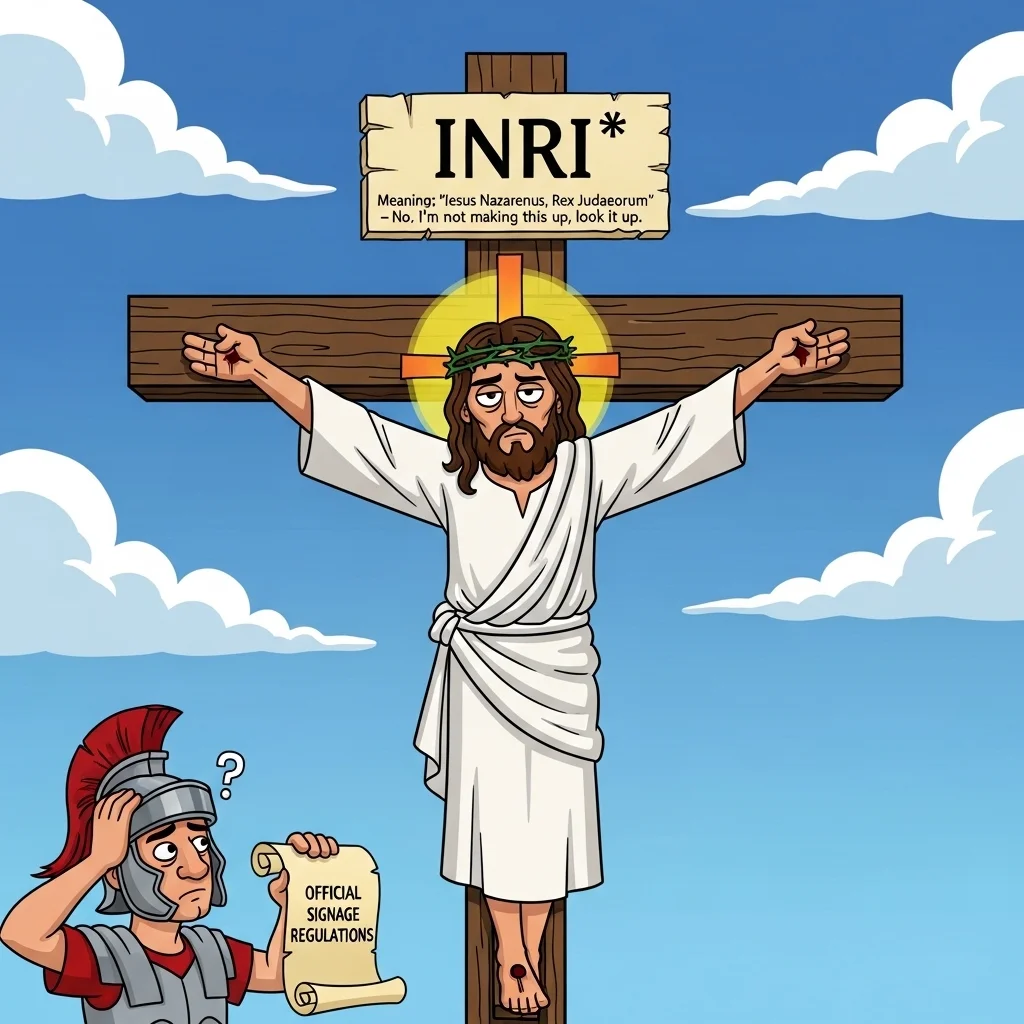
The INRI meaning in Bible comes from a Latin phrase:
Iesus Nazarenus Rex Iudaeorum
This translates to:
“Jesus of Nazareth, King of the Jews.”
The inscription was ordered by Pontius Pilate, the Roman governor who authorized the crucifixion of Jesus Christ.
According to Gospel of John 19:19–20, Pilate had the inscription written and placed on the cross. It was written in Latin, Greek, and Hebrew so that everyone passing by could read it.
This wasn’t random.
It was intentional.
Biblical Reference: Where INRI Appears
The clearest account of the inscription appears in John’s Gospel:
“Pilate had a notice prepared and fastened to the cross. It read: Jesus of Nazareth, the King of the Jews.”
Other Gospels mention the charge as well:
Gospel of Matthew 27:37
Gospel of Mark 15:26
Gospel of Luke 23:38
While wording varies slightly, the message is consistent.
The charge against Jesus was claiming to be King.
Why Was INRI Written in Three Languages?
This detail is powerful and often overlooked.
The inscription was written in:
Latin – the language of the Roman Empire
Greek – the common language of the Eastern Mediterranean
Hebrew (or Aramaic) – the religious language of the Jewish people
This ensured maximum visibility.
It was like posting something today in English, Spanish, and Mandarin at once — impossible to ignore.
The crucifixion took place at Golgotha, also known as Calvary. It was a public execution site along a busy road.
Pilate wanted everyone to see the charge.
The Political Meaning Behind INRI
Understanding the INRI meaning in Bible requires stepping into the political climate of the time.
The Roman Empire did not tolerate rival kings.
Declaring oneself “King of the Jews” could be seen as rebellion against Roman Empire authority.
To Rome, this was treason.
To the Jewish religious leaders, it was blasphemy.
To Christians, it was truth.
Pilate likely intended the sign as mockery. A sarcastic jab at both Jesus and the Jewish leaders who demanded His death.
But here’s the irony:
What was meant as ridicule became a declaration of divine identity.
Symbolism of INRI in the Bible
The INRI meaning in Bible carries deep symbolic layers:
1. Public Declaration of Kingship
Jesus had spoken of a kingdom “not of this world” (John 18:36). Yet here, nailed to a cross, He is officially declared King.
Not crowned with gold — but with thorns.
Not enthroned on velvet — but on wood.
2. Fulfillment of Prophecy
Old Testament passages foretold a coming King from David’s line:
Isaiah 9:6–7
Zechariah 9:9
The inscription unintentionally confirmed these prophecies.
3. Universal Message
Because it was written in multiple languages, the message symbolized something larger:
Christ’s kingship extends beyond one nation.
It hinted at a global mission.
Table: Political vs Spiritual Interpretation of INRI
| Perspective | Meaning of INRI | Intended Message | Deeper Outcome |
|---|---|---|---|
| Roman Authority | Criminal charge | Mockery of a failed rebel | Public humiliation |
| Jewish Leaders | False claim | Blasphemy | Rejection of Messiah |
| Early Christians | Truth of identity | Divine kingship | Fulfillment of prophecy |
| Modern Believers | Spiritual authority | Eternal kingship | Hope and salvation |
This contrast is crucial to understanding the INRI meaning in Bible.
Case Study: Pilate’s Refusal to Change the Sign
According to John 19:21–22, Jewish leaders objected. They wanted the inscription to say:
“He claimed to be King of the Jews.”
Pilate refused.
He said:
“What I have written, I have written.”
This moment is fascinating.
Pilate, who didn’t fully understand Jesus, ends up defending the inscription. In doing so, he unknowingly preserved a theological truth.
Sometimes God uses unlikely people to declare His purposes.
Cultural Impact of INRI
The INRI meaning in Bible didn’t stay confined to Scripture.
It spread across:
Christian art
Church architecture
Crucifixes
Medieval paintings
Renaissance masterpieces
Many crucifixes still bear the letters INRI above Christ’s head.
Artists across centuries used it to reinforce Christ’s royal identity.
In Western culture especially, INRI became synonymous with the crucifixion scene.
Psychological Angle: Why Titles Matter
Titles shape perception.
If someone is labeled “criminal,” you see them one way.
If labeled “king,” you see them differently.
INRI forces a psychological confrontation:
Was Jesus a fraud?
Or was He truly King?
The inscription demands a response.
It creates cognitive tension — and invites reflection.
That’s part of its enduring power.
Spiritual Meaning of INRI in the Bible
Now we move deeper.
The spiritual dimension of the INRI meaning in Bible reveals something profound.
1. Kingship Through Sacrifice
Earthly kings conquer with armies.
Christ conquered through surrender.
The cross becomes a throne.
2. Victory Hidden in Defeat
From a human perspective, crucifixion meant failure.
From a spiritual perspective, it meant redemption.
Colossians 2:15 says Christ disarmed powers and authorities at the cross.
The sign meant humiliation.
It became victory.
3. A Kingdom Not of This World
Jesus clarified His kingdom was not political. It was spiritual.
INRI reminds believers that true authority isn’t based on force — but on truth.
Comparison: INRI vs Other Crucifixion Charges
Roman crucifixions often included charges like:
“Thief”
“Murderer”
“Rebel”
But Jesus’ sign was different.
It declared royalty.
That alone sets the crucifixion apart.
Theological Reflections on INRI
The INRI meaning in Bible invites theological reflection on several levels:
Christology (Study of Christ)
It confirms Jesus’ messianic identity.
Soteriology (Study of Salvation)
The King dies for His people.
Ecclesiology (Study of the Church)
Believers recognize Christ as their sovereign Lord.
The inscription becomes a foundational confession of faith.
Practical Lessons from INRI
How does this apply today?
1. Truth Can Be Mocked — But It Stands
Pilate meant sarcasm.
God meant sovereignty.
2. Identity Is Not Determined by Circumstances
Jesus looked defeated.
He was reigning.
3. Public Faith Matters
The inscription was public. Faith is not merely private belief — it has public implications.
Modern Application: What Does INRI Mean for Believers Today?
For Christians, the INRI meaning in Bible is not decorative.
It’s declarative.
It says:
Christ is King even in suffering.
God’s plans prevail despite opposition.
Apparent defeat may hide divine purpose.
In a world obsessed with power, INRI redefines it.
Power is not control.
It’s sacrificial love.
