
Who Was Barabbas in the Bible?
Barabbas appears in all four Gospels:
Gospel of Matthew
Gospel of Mark
Gospel of Luke
Gospel of John
He was a prisoner at the time of Jesus’ trial before the Roman governor Pontius Pilate.
The Gospels describe him as:
A rebel
An insurrectionist
A murderer
A notorious prisoner
In Mark 15:7, Barabbas is identified as someone involved in an uprising against Roman authority—likely part of a violent revolutionary movement.
He was not a petty thief. He was a serious criminal.
Yet he was released.
What Does the Name Barabbas Mean?
The Barabbas meaning in Bible begins with his name.
“Barabbas” comes from Aramaic:
Bar = son
Abba = father
So, Barabbas literally means:
“Son of the father.”
This detail is astonishing.
Jesus is repeatedly called the Son of the Father—the Son of God.
Now imagine the irony:
The crowd chooses “son of the father” (a criminal)
Instead of the true Son of the Father.
Some ancient manuscripts of Matthew even record his full name as “Jesus Barabbas,” meaning “Jesus, son of the father.” Though not included in most modern translations, this historical note intensifies the symbolism.
The Barabbas meaning in Bible becomes layered and profound.
The Cultural Background: The Passover Custom
During the Jewish feast of Passover, it was customary for the Roman governor to release one prisoner chosen by the crowd.
This tradition appears in:
Gospel of Matthew 27:15
Gospel of Mark 15:6
Passover commemorated Israel’s deliverance from Egypt. It celebrated freedom from oppression.
Ironically, during a feast about liberation, the people chose to free a violent rebel instead of the Prince of Peace.
Culturally, many Jews hoped for a political Messiah—someone who would overthrow Rome. Barabbas, as a revolutionary, may have represented that expectation.
Jesus, however, preached love, forgiveness, and a spiritual kingdom.
The crowd chose force over faith.
The Courtroom Scene: A Case Study in Human Nature
Let’s examine the dramatic scene.
The Players:
Pontius Pilate – Roman authority figure
Jesus Christ – Accused Messiah
Barabbas – Convicted rebel
Religious leaders – Pressuring for Jesus’ death
The crowd – Influenced and emotional
Pilate presents the choice:
“Whom shall I release to you?”
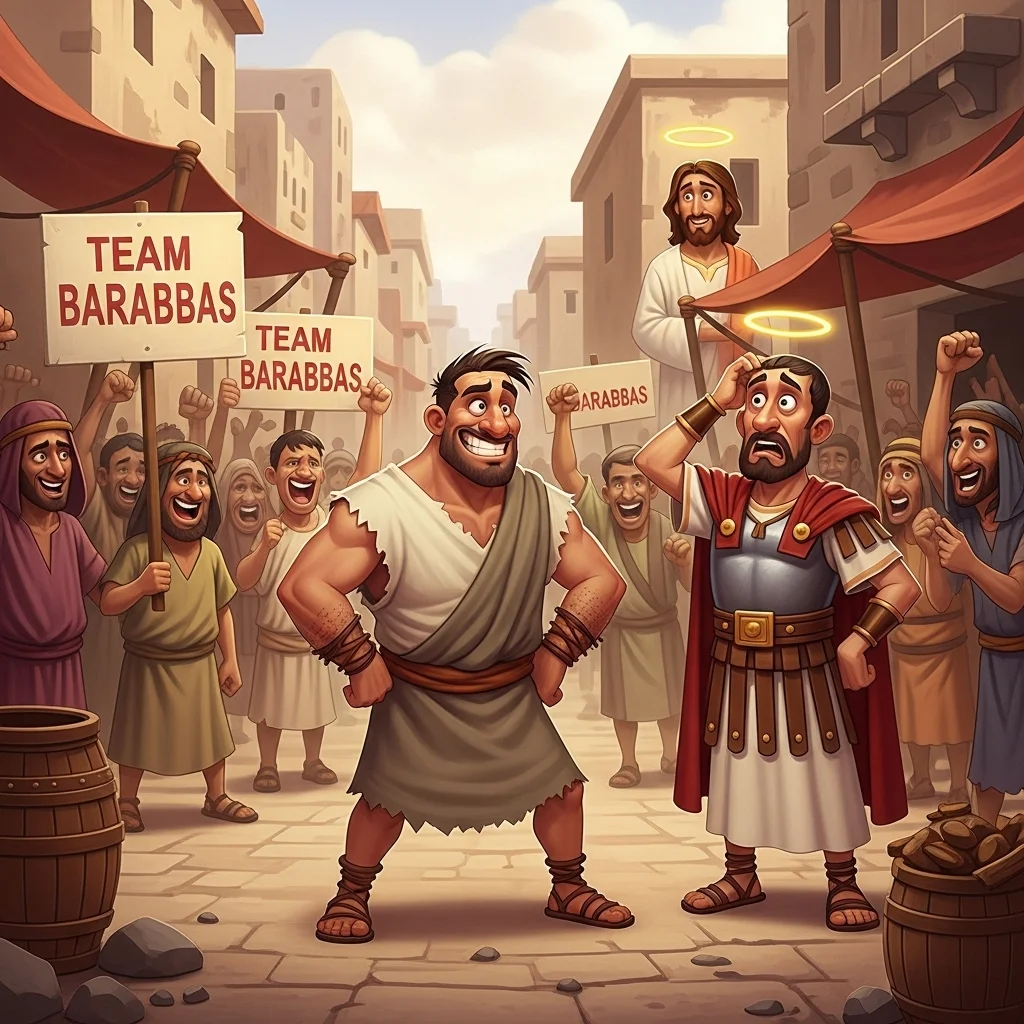
The crowd shouts: “Barabbas!”
This moment highlights:
Mob psychology
Political pressure
Spiritual blindness
Moral weakness
Pilate knew Jesus was innocent. Yet he yielded to public demand.
The Barabbas meaning in Bible reveals how easily truth can be rejected when emotion and politics take over.
Symbolism: Barabbas as a Picture of Substitution
The most powerful dimension of the Barabbas meaning in Bible is substitution.
Barabbas was guilty.
Jesus was innocent.
Barabbas was freed.
Jesus was crucified.
This exchange mirrors the central message of Christianity:
The guilty are released.
The innocent takes their place.
Barabbas becomes a living symbol of humanity.
In theological terms:
He represents sinners.
Jesus represents the sacrificial substitute.
Barabbas walked away from the cross that had his name on it.
Jesus carried it instead.
Spiritual Meaning: A Portrait of Grace
The Barabbas meaning in Bible beautifully illustrates grace.
Grace is unearned favor.
Barabbas did nothing to deserve freedom. He didn’t repent publicly. He didn’t negotiate.
He simply received release.
Spiritually, the story shows:
Salvation is not earned.
Freedom is a gift.
Innocence can suffer for the guilty.
This aligns with the broader biblical theme found in Isaiah 53 and echoed throughout the New Testament.
Barabbas becomes a silent testimony of divine mercy.
Psychological Angle: Why Did the Crowd Choose Barabbas?
Human behavior in this story is fascinating.
Why would a crowd choose a murderer over a healer?
Several psychological factors may explain:
| Factor | Explanation |
|---|---|
| Fear of Rome | A revolutionary felt stronger |
| Political expectation | They wanted a military Messiah |
| Influence | Religious leaders stirred the crowd |
| Groupthink | Individuals followed majority emotion |
| Disappointment | Jesus didn’t meet their expectations |
People often choose what aligns with their desires—even if it’s destructive.
The Barabbas meaning in Bible reveals how easily humans can reject truth when it challenges comfort.
Cultural and Historical Impact
Throughout Christian history, Barabbas has been viewed as:
A symbol of humanity
A representation of substitutionary atonement
A picture of moral contrast
Early church writers often emphasized that Barabbas’ release illustrates the Gospel message in dramatic form.
Artists, theologians, and preachers have revisited this moment for centuries because it captures the heart of Christian theology in a single event.
Modern-Day Application: How We Choose “Barabbas” Today
The story is not just ancient history.
We choose “Barabbas” when:
We prefer convenience over truth
We follow crowds instead of conscience
We reject spiritual transformation for worldly solutions
We demand quick fixes instead of lasting change
In daily life, people often choose:
Anger over forgiveness.
Revenge over mercy.
Pride over humility.
The Barabbas meaning in Bible challenges us to ask:
What are we choosing?
Practical Lessons from the Story of Barabbas
1. Examine Your Expectations
Are you expecting God to act politically, socially, or spiritually?
The crowd rejected Jesus because He didn’t fit their mold.
2. Resist Crowd Pressure
Truth is not determined by volume.
3. Recognize Grace
Like Barabbas, we all benefit from undeserved mercy.
4. Choose Wisely
Every day presents choices between what feels powerful and what is truly righteous.
A Powerful Comparison: Jesus vs. Barabbas
| Jesus | Barabbas |
|---|---|
| Innocent | Guilty |
| Preached peace | Participated in rebellion |
| Healed others | Caused harm |
| Accepted death | Escaped execution |
| Son of God | “Son of the father” |
This contrast deepens the Barabbas meaning in Bible. It’s not just about two men. It’s about two paths.
One path leads to sacrifice and redemption.
The other represents human rebellion.
