

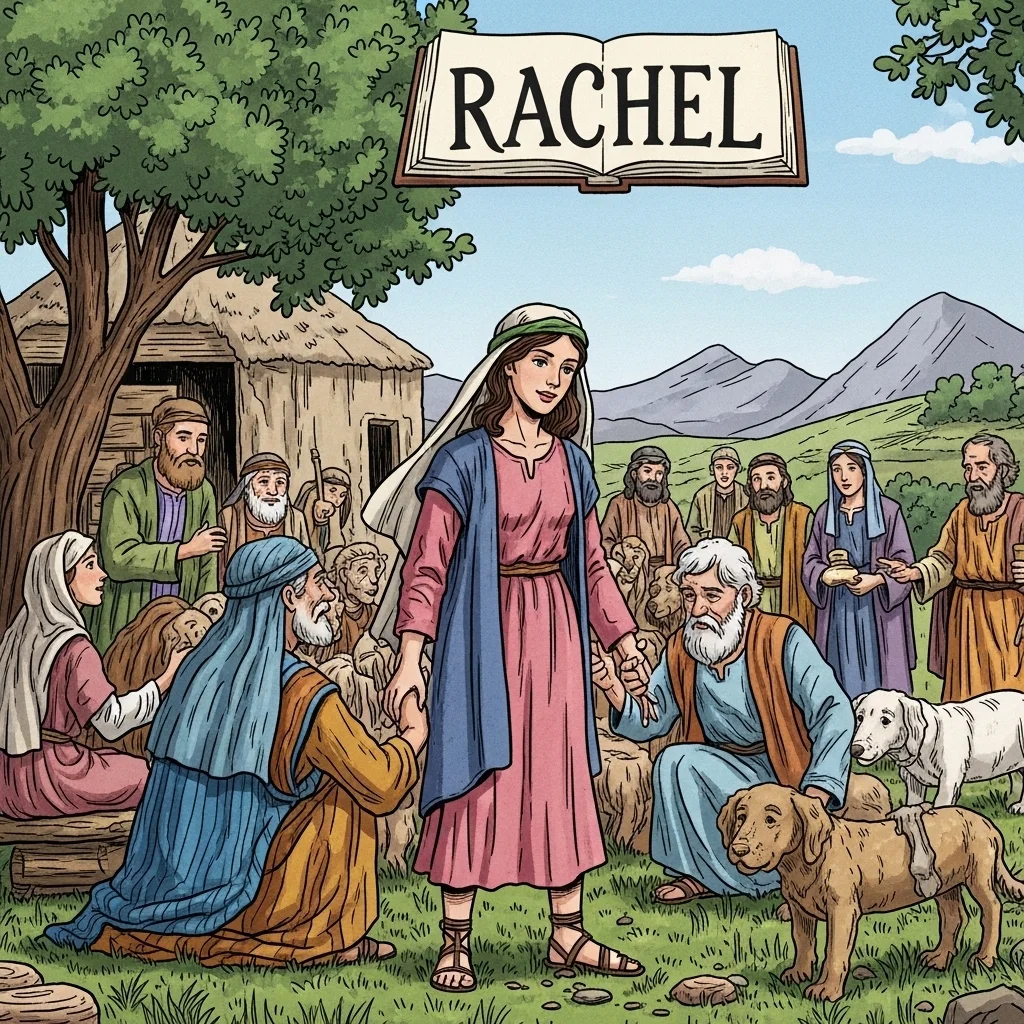
Characteristics of Rachel in the Bible
Rachel is one of the most well-known women in the Bible and the beloved wife of Jacob. Her character is marked by beauty, love, perseverance, and a deep desire for family. The Bible describes Rachel as physically attractive and greatly loved by Jacob, who worked fourteen years to marry her (Genesis 29:18–30).
Some key characteristics of Rachel include:
- Beauty and grace (Genesis 29:17)
- Deeply loved by her husband Jacob (Genesis 29:20)
- Persistent in her desire to have children (Genesis 30:1)
- Faithful member of God’s covenant family
- Mother of Joseph and Benjamin, two important figures in Israel’s history
Rachel’s life also reveals human struggles such as jealousy, impatience, and sorrow, making her a relatable biblical figure whose story demonstrates both faith and human weakness.
Spiritual Meaning of the Name Rachel
The name Rachel comes from the Hebrew word Raḥel (רָחֵל), meaning “ewe” or “female sheep.” In biblical culture, sheep often symbolized gentleness, innocence, care, and dependence on God.
Spiritually, the name Rachel is often associated with:
- Compassion and nurturing love
- Family devotion
- God’s faithfulness through difficult circumstances
- Hope and perseverance
Rachel’s story reminds believers that God sees their struggles and can fulfill His purposes even during seasons of waiting and disappointment.
Story of Rachel in the Bible Summary
Rachel’s story is primarily found in Genesis 29–35. She was the younger daughter of Laban and became the wife of Jacob.
Jacob met Rachel while she was tending her father’s sheep and immediately fell in love with her. He agreed to work seven years for Laban in exchange for marrying Rachel. However, Laban deceived him and gave him Leah, Rachel’s older sister, as his wife. Jacob then worked another seven years to marry Rachel.
For many years Rachel was unable to have children, while Leah bore several sons. After a period of infertility, God blessed Rachel with a son named Joseph.
“Then God remembered Rachel; he listened to her and enabled her to conceive.” (Genesis 30:22)
Later, Rachel gave birth to Benjamin but died during childbirth (Genesis 35:16–19). Despite her tragic death, she became one of the matriarchs of Israel and the mother of two important tribes.
Where Is the Story of Rachel in the Bible?
Rachel’s story is found mainly in the Book of Genesis, especially:
- Genesis 29 – Jacob meets Rachel and marries her.
- Genesis 30 – Rachel struggles with infertility and gives birth to Joseph.
- Genesis 31 – Rachel leaves her father’s household with Jacob.
- Genesis 35 – Rachel gives birth to Benjamin and dies.
These chapters provide the primary account of her life and role in the history of Israel.
Why Did Rachel Cry in the Bible?
Rachel is most famously associated with weeping in Jeremiah 31:15:
“A voice is heard in Ramah, mourning and great weeping, Rachel weeping for her children and refusing to be comforted, because they are no more.”
This verse uses Rachel symbolically as a mother mourning for the people of Israel. Since Rachel was considered one of the mothers of the nation, the prophet portrayed her as grieving over the suffering and exile of her descendants.
The verse is later quoted in Matthew 2:17–18 after King Herod ordered the killing of infant boys in Bethlehem. Matthew presents Rachel’s weeping as a symbol of the sorrow experienced by the mothers who lost their children.
What Can We Learn from Rachel in the Bible?
Rachel’s life offers several important spiritual lessons:
1. God Hears Our Prayers
Rachel endured years of infertility, but God eventually answered her prayers.
“Then God remembered Rachel; he listened to her and enabled her to conceive.” (Genesis 30:22)
2. Waiting Requires Faith
Her story teaches that God’s timing may differ from our own, but His plans remain trustworthy.
3. Jealousy Can Lead to Pain
Rachel struggled with jealousy toward Leah, reminding believers of the importance of contentment and trust in God.
4. God Works Through Imperfect People
Despite her flaws and struggles, Rachel became an important part of God’s covenant plan.
5. Family and Legacy Matter
Rachel’s sons, Joseph and Benjamin, played significant roles in Israel’s history, demonstrating how God can use future generations to accomplish His purposes.
Rachel Meaning in Greek
Rachel is a Hebrew name rather than a Greek name. In the Greek translation of the Old Testament, known as the Septuagint, the name appears as Rhachēl (Ραχήλ), which is simply a transliteration of the Hebrew name.
The original Hebrew meaning remains “ewe” or “female sheep.” Therefore, even in Greek usage, the spiritual symbolism of gentleness, care, and nurturing remains connected to the name Rachel.
Who Is Rachel in the Bible Matthew?
In the Gospel of Matthew, Rachel is not presented as a living character but is mentioned through a quotation from Jeremiah.
Matthew 2:17–18 cites Jeremiah 31:15:
“A voice is heard in Ramah, weeping and great mourning, Rachel weeping for her children and refusing to be comforted, because they are no more.”
Matthew applies this prophecy to the sorrow that followed Herod’s massacre of the infants in Bethlehem. Rachel serves as a symbolic mother of Israel who mourns for her descendants. Her mention emphasizes the deep grief experienced by the families affected by this tragic event and highlights God’s awareness of human suffering.
What Does Rachel Mean in the Bible?
The Rachel meaning in Bible comes from the Hebrew word “רָחֵל” (Raḥel), which means:
“Ewe” (female sheep)
At first glance, that may seem simple. But in biblical culture, sheep symbolized:
Gentleness
Beauty
Innocence
Nurturing
Value
A ewe was especially precious because she produced offspring and sustained families.
So the Rachel meaning in Bible carries strong themes of:
Tenderness
Fruitfulness
Beloved identity
Covenant lineage
Who Was Rachel in the Bible?
Rachel was one of the central matriarchs of Israel. Her story is told primarily in the book of Genesis.
She was:
The daughter of Laban
The beloved wife of Jacob
The mother of Joseph and Benjamin
Rachel’s life shaped biblical history in profound ways.
Rachel Meaning in Bible: The Love Story That Changed History
Rachel first appears when Jacob meets her at a well. Scripture describes her as beautiful in form and appearance.
Jacob immediately falls in love.
He agrees to work seven years to marry her—but is deceived into marrying her sister Leah first. He then works another seven years for Rachel.
This powerful story reveals something important about the Rachel meaning in Bible:
Rachel represents deep love worth sacrifice.
Fourteen years of labor for one woman speaks volumes about her value and influence.
Symbolism Behind Rachel Meaning in Bible
The Rachel meaning in Bible carries multiple layers of symbolism.
1. Beauty and Desire
Rachel is described as beautiful. But her beauty isn’t shallow—it symbolizes:
Emotional depth
Desired covenant blessing
God’s unfolding plan
2. Delayed Fulfillment
Rachel struggled with infertility for many years.
While her sister bore children, Rachel waited.
This delay symbolizes:
Testing of faith
Emotional longing
Dependence on God
Eventually, God opened her womb, and she gave birth to Joseph.
3. Mother of a Nation
Rachel became the mother of:
Joseph – who saved Israel during famine
Benjamin – founder of the tribe that later produced King Saul
Her lineage influenced generations.
The Rachel meaning in Bible includes legacy and divine destiny.
Rachel’s Pain: A Deeper Emotional Layer
Rachel’s life was not easy.
She faced:
Sibling rivalry
Emotional jealousy
Delayed motherhood
Death during childbirth
When she gave birth to Benjamin, she named him “Ben-Oni,” meaning “son of my sorrow.” Jacob later renamed him Benjamin.
This shows the Rachel meaning in Bible also includes:
Vulnerability
Emotional struggle
Human imperfection
Rachel wasn’t flawless. She was real.
Case Study: Joseph – The Fulfillment of Rachel’s Hope
Rachel’s first son, Joseph, became one of the most influential figures in Scripture.
Joseph rose from slavery to leadership in Egypt. His wisdom preserved the nation during famine.
Without Rachel, there would be no Joseph.
Here’s how Rachel’s legacy unfolded:
| Rachel’s Action | Long-Term Impact |
|---|---|
| Prayed for a child | Birth of Joseph |
| Raised Joseph | Developed character |
| Endured struggle | Built spiritual resilience |
| Gave birth to Benjamin | Tribe continued |
The Rachel meaning in Bible shows that personal pain can produce generational blessing.
Cultural Significance of Rachel
In Jewish tradition, Rachel is considered one of the four matriarchs of Israel (alongside Sarah, Rebekah, and Leah).
Her tomb near Bethlehem remains a significant pilgrimage site.
Rachel is remembered as:
A weeping mother
A symbol of national sorrow
A figure of compassion
In the book of Jeremiah 31:15, Rachel is poetically described as weeping for her children.
This verse is later referenced in the book of Matthew, connecting her to the sorrow during King Herod’s massacre.
The Rachel meaning in Bible therefore also includes:
A mother who represents collective grief and hope.
Psychological Angle: Rachel and Human Longing
Rachel’s story speaks directly to human emotion.
She experienced:
Comparison with others
Jealousy
Desire for recognition
Desire for children
Psychologically, Rachel represents the struggle of feeling “less than” while waiting for breakthrough.
Her story reminds us:
Waiting seasons do not define your worth
Comparison steals peace
God’s timing is purposeful
The Rachel meaning in Bible reflects the internal battle many people face today.
Spiritual Angle: Faith in the Waiting
Rachel cried out, “Give me children, or I die.”
It was an intense expression of pain.
But eventually, God remembered Rachel.
This phrase appears repeatedly in Scripture: “God remembered.”
The Rachel meaning in Bible teaches:
God sees silent tears
Divine delay is not divine denial
God fulfills promises in His time
Rachel’s life shows that faith sometimes looks like holding on when nothing changes.
Rachel Meaning in Bible vs. Leah: A Comparison
Rachel and Leah offer powerful contrasts.
| Rachel | Leah |
|---|---|
| Beautiful | Not described as beautiful |
| Loved deeply by Jacob | Less loved |
| Struggled with infertility | Had many children |
| Desired fruitfulness | Desired love |
Both women represent different spiritual lessons.
The Rachel meaning in Bible focuses on beloved identity and delayed blessing, while Leah represents overlooked faithfulness.
Together, they show that God works through both desire and difficulty.
Modern-Day Application of Rachel Meaning in Bible
So what does the Rachel meaning in Bible mean for you today?
1. Your Waiting Has Purpose
Rachel waited years for her breakthrough.
Your delay may be preparation.
2. Love Requires Sacrifice
Jacob worked 14 years for Rachel.
True love involves commitment.
3. Pain Can Create Legacy
Rachel’s son Joseph became a deliverer.
Your struggles may shape future victories.
4. Identity Is Not Defined by Comparison
Rachel compared herself to Leah.
But both had different destinies.
Rachel Meaning in Bible in Christian Perspective
In Christian theology, Rachel’s sorrow in Jeremiah foreshadows grief connected to Jesus’ early life.
Her story points toward:
Redemption
Restoration
Messianic hope
Rachel represents the tension between sorrow and salvation.
The Name Rachel Today
The name Rachel remains popular worldwide.
Parents choose it because it represents:
Grace
Beauty
Strength through struggle
Biblical heritage
